
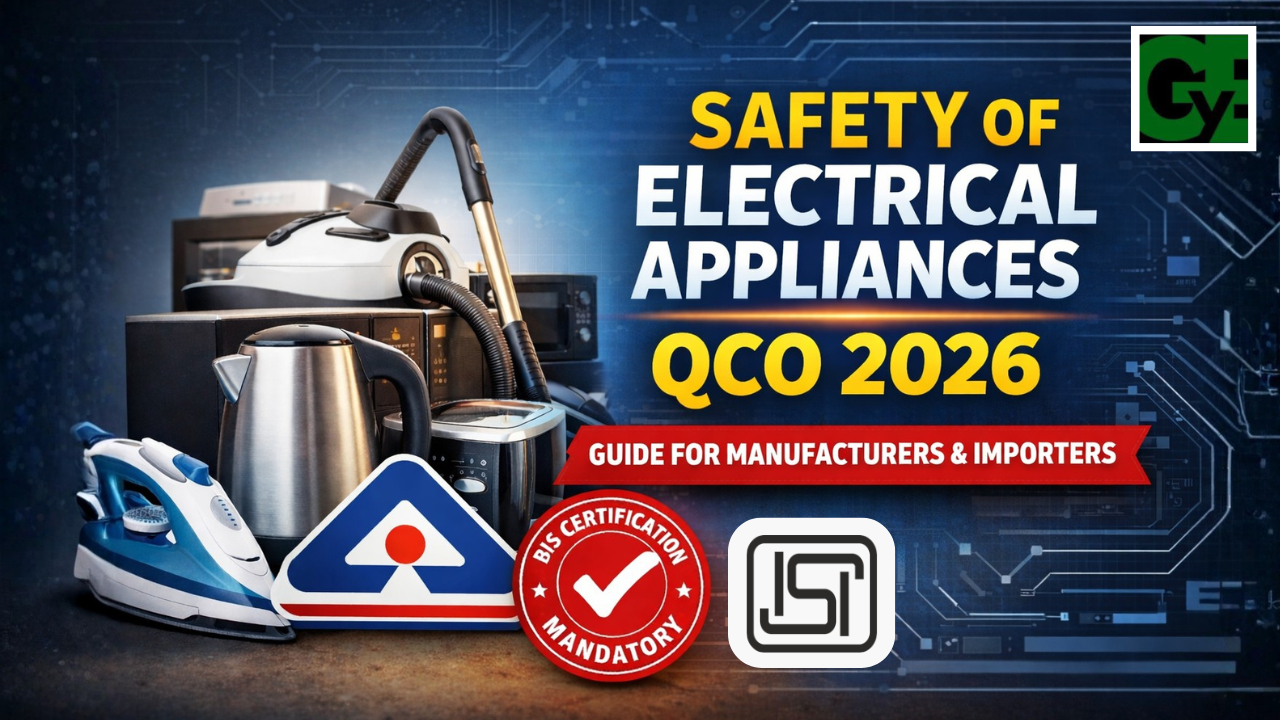
The Government of India has introduced the Safety of Household, Commercial and Similar Electrical Appliances (Quality Control) Order, 2026, a significant regulatory step to ensure product safety, quality and consumer protection across the country.
If you are a manufacturer, importer, or seller of electrical appliances, this update directly impacts your business operations. In this blog, we break down everything you need to know in simple terms.
Quality Control Order for Electrical Appliances
The Quality Control Order (QCO) 2026 has been issued under the Bureau of Indian Standards (BIS) Act, 2016 to make BIS certification mandatory for a wide range of electrical appliances.
This order replaces the earlier 2025 notification and strengthens compliance requirements for safety standards.
Applicability: Which Products Are Covered?
The QCO applies to:
- Household electrical appliances
- Commercial electrical equipment
- Similar-use electrical products
Voltage Criteria:
- Up to 250V (single-phase appliances)
- Up to 480V (other appliances including DC & battery-operated)
Mandatory BIS Certification Requirement
Under this order:
- All listed products must comply with IS 302 (Part 1): 2024 / IEC 60335-1:2020 standards
- Products must carry the BIS Standard Mark (ISI Mark)
- Certification must be obtained under Scheme-I of BIS
Without BIS certification, manufacturing, importing, or selling these products will be illegal.
Implementation Timeline
The compliance deadlines are:
| Category | Effective Date |
|---|---|
| General (Large Enterprises) | 1 October 2026 |
| Small Enterprises | 1 January 2027 |
| Micro Enterprises | 1 April 2027 |
Safety of Electrical Appliances QCO 2026
Key Exemptions You Should Know
The QCO provides certain exemptions:
1. Export-Only Products–
Products manufactured only for export do not require BIS certification.
2. R&D Imports–
- Up to 200 units per year can be imported for research purposes
- These cannot be sold commercially
3. Existing Stock Clearance–
Manufacturers can:
- Sell existing stock (produced/imported before implementation)
- Within 6 months after the effective date
- With proper declaration to BIS
Penalty for Non-Compliance
Non-compliance with this QCO will attract penalties under the BIS Act, 2016, which may include:
- Heavy fines
- Product seizure
- Legal action
- Ban on sales
This makes compliance not optional but mandatory.
Importance of this QCO
This regulation aims to:
- Improve consumer safety
- Eliminate substandard products
- Ensure quality consistency
- Boost trust in Indian markets
Conclusion
At GYE LLP, we specialize in BIS certification and regulatory compliance.
The Electrical Appliances QCO 2026 is a major step towards strengthening product safety in India. However, it also introduces strict compliance requirements that businesses must follow.
If you deal with electrical appliances, this is the right time to start your BIS certification process to avoid last-minute delays or penalties.
How GYE LLP Can Help You
We help you with:
- Product category identification
- Applicable IS standard mapping
- Documentation & application filing
- Testing coordination with labs
- End-to-end BIS certification support
Whether you are a manufacturer or importer, we ensure fast and hassle-free compliance.
Need for BIS Certification?
📞 Contact GYE LLP today and get expert guidance on complying with the latest QCO regulations.
Email: satjindal@yahoo.co.in
Phone: +91 9313058678, 9718925753
Leave a Reply