
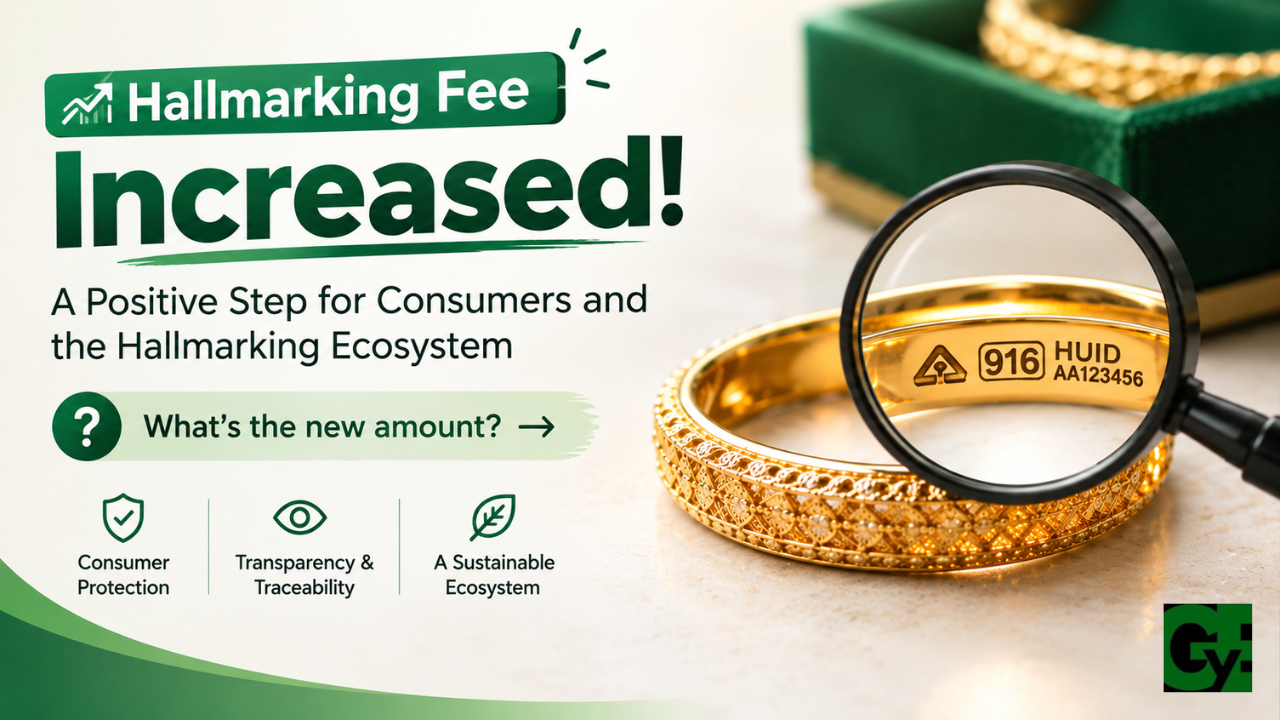
The increase in the hallmarking rate to Rs 75 per article is an appreciable and timely step towards strengthening the Assaying and Hallmarking (A&H) system in India. While the revision may appear to be a modest increase in the cost associated with hallmarking, its broader significance lies in ensuring that Assaying and Hallmarking Centres have adequate value to undertake testing and hallmarking in accordance with the prescribed standards, including IS 15820.
Hallmarking is fundamentally a system of consumer protection. It provides assurance that precious-metal articles have been independently tested for purity and carry the required identification for verification and traceability. For this system to remain credible, efficient and sustainable, the infrastructure and services supporting testing and hallmarking must also be adequately valued.
Supporting Quality Testing and Hallmarking
Assaying and Hallmarking Centres play a critical role in the jewellery supply chain. Their responsibility extends beyond simply applying a hallmark. The process involves appropriate testing, verification, documentation and compliance with the applicable standards and regulatory requirements.
The revision of the hallmarking rate to Rs 75 per article can help A&H Centres meet the operational costs associated with carrying out these activities properly. Adequate remuneration is important to maintain trained manpower, testing infrastructure, equipment, calibration, quality systems and other facilities required for reliable hallmarking services.
A financially sustainable A&H ecosystem ultimately contributes to the integrity of the hallmarking system itself.
A Direct Benefit to Consumers
The real beneficiary of a strong hallmarking system is the consumer.
When purchasing gold or other precious-metal jewellery, consumers want confidence that the article they are buying meets the declared purity. Hallmarking provides an important layer of assurance in this regard.
The presence of the Hallmark Unique Identification (HUID) further strengthens this confidence. Consumers can use the HUID to verify relevant details and establish greater transparency regarding the hallmarked article.
This traceability is particularly valuable in today’s jewellery market, where consumers are increasingly aware of purity, authenticity and the importance of documentation. The ability to identify and trace a hallmarked article gives consumers greater confidence at the time of purchase and supports transparency throughout the value chain.
HUID and the Importance of Traceability
The introduction and use of HUID have significantly enhanced the traceability aspect of hallmarking. Each hallmarked article can be associated with a unique identification, making the hallmarking process more transparent and verifiable.
For consumers, this means that hallmarking is no longer merely a mark stamped on a jewellery article. It is part of a broader system involving testing, identification, documentation and traceability.
This is an important evolution in the Indian jewellery sector. As consumers become more informed, access to verifiable information will increasingly influence purchasing decisions.
The Need for a Sustainable Hallmarking Ecosystem
A robust hallmarking system requires cooperation among all stakeholders-consumers, jewellers, manufacturers, Assaying and Hallmarking Centres and regulatory authorities.
The revision to Rs 75 per article should therefore be viewed not simply as an increase in a service charge, but as an investment in maintaining the effectiveness and sustainability of the hallmarking infrastructure.
Testing and hallmarking are technical activities that require proper facilities, skilled personnel and adherence to prescribed procedures. If the system is expected to deliver accurate testing, reliable identification and effective traceability, the institutions performing these functions must be able to operate sustainably.
Strengthening Consumer Confidence
Consumer confidence is one of the most important pillars of the jewellery industry. A transparent and dependable hallmarking system can play a significant role in building that confidence.
The combination of testing as per applicable standards, hallmarking and HUID-based traceability provides consumers with a stronger mechanism for making informed purchasing decisions.
Therefore, the increase in the hallmarking rate to Rs 75 per article is, in principle, an appreciable measure. It can facilitate A&H Centres in receiving appropriate value for the services and infrastructure required for testing and hallmarking, while simultaneously supporting the larger objective of consumer protection.
How GYE LLP Can Help Assaying and Hallmarking Centres
A sustainable hallmarking ecosystem also depends on the ability of Assaying and Hallmarking Centres to maintain robust quality, documentation, operational and compliance systems.
GYE LLP can support Assaying and Hallmarking Centres in strengthening their management systems and improving process effectiveness in line with applicable standards and regulatory requirements.
Our support can include:
- Management System Implementation and Strengthening
- Documentation and Process Standardisation
- Quality Management System (QMS) Support
- Internal Audit and Compliance Support
- Risk Identification and Process Improvement
- Corrective and Preventive Action (CAPA) Support
- Training and Awareness of Personnel
- Support for Maintaining Traceability and Documentation
- Preparation for Certification, Assessment and Regulatory Requirements
By strengthening processes, documentation, quality controls and continual improvement practices, GYE LLP can help A&H Centres build a more systematic and sustainable operational framework.
A well-structured management system can support A&H Centres in delivering consistent, reliable and traceable hallmarking services—ultimately contributing to greater confidence among jewellers, manufacturers, regulators and consumers.
Conclusion
The hallmarking system can be successful only when it is reliable, transparent and sustainable. The increase in the hallmarking rate to Rs 75 per article can contribute to achieving these objectives by enabling Assaying and Hallmarking Centres to adequately support the testing and hallmarking process in accordance with IS 15820 and other applicable requirements.
Most importantly, a stronger and sustainable hallmarking ecosystem is ultimately in the interest of consumers. With HUID providing an additional layer of identification and traceability, consumers can have greater confidence while purchasing hallmarked jewellery and verifying the identity of their articles.
The objective should therefore be to view hallmarking not merely as a regulatory requirement or an additional cost, but as an essential quality, transparency and consumer-confidence mechanism for the precious-metals sector.
A well-supported A&H network, backed by appropriate remuneration and effective traceability through HUID, can help take Indian hallmarking to an even higher level of credibility and consumer trust.
Leave a Reply