
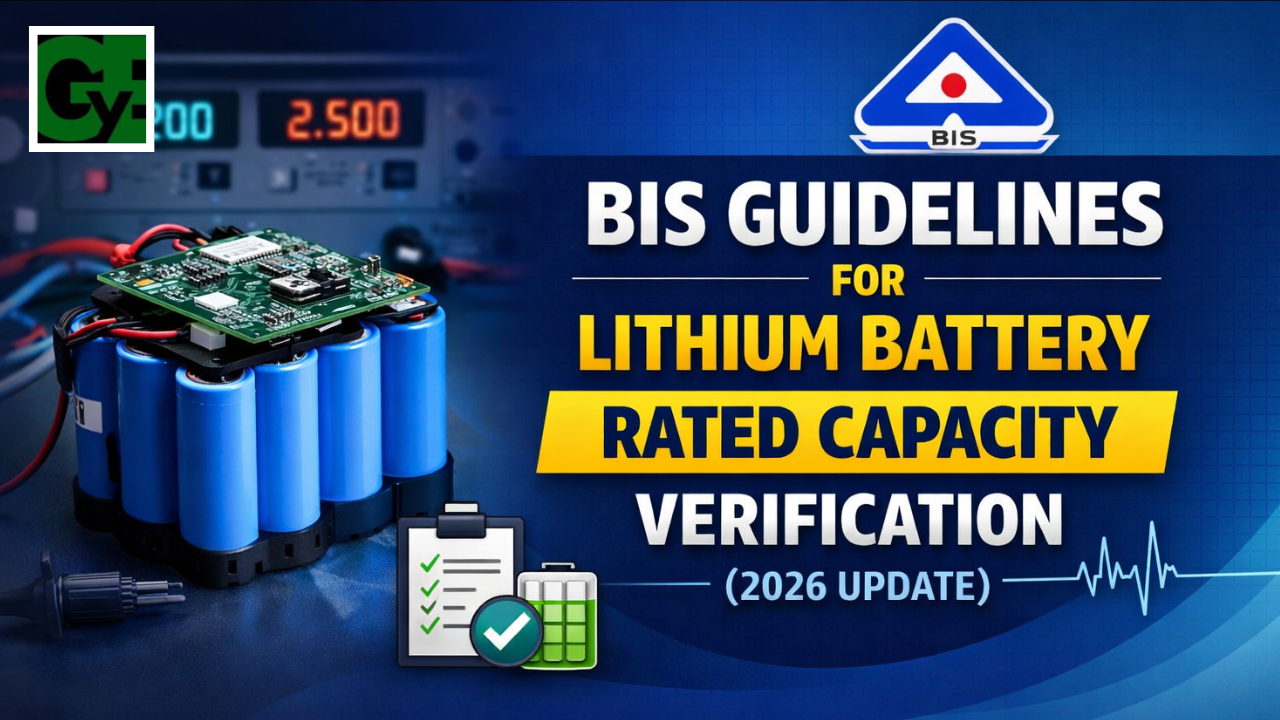
The Bureau of Indian Standards (BIS), in coordination with the Ministry of Electronics and Information Technology, has issued new guidelines for the verification of rated capacity of lithium-ion cells and batteries.
These guidelines are essential for manufacturers, importers, and businesses operating under the BIS Compulsory Registration Scheme (CRS).
Background of the New Guidelines
Lithium-ion batteries are governed under:
- IS 16046 (Part 2): 2018 / IEC 62133-2: 2017
- Notified under the Electronics and IT Goods (Compulsory Registration) Order, 2021
Due to multiple instances of misdeclaration of battery capacity, MeitY has mandated the measurement and verification of rated capacity to protect consumer interests.
What is Rated Capacity Verification?
Rated capacity refers to the actual energy storage capacity of a lithium battery, which must match the declared value on the product.
As per the updated BIS guidelines:
- Testing must be conducted as per Clause 7.3.1 of IS 16047 (Part 3): 2018
- The test is based on discharge performance at 20°C
This ensures that battery performance claims are accurate and reliable.
Applicability of the Guidelines
These guidelines apply to:
- Portable sealed secondary lithium cells
- Lithium-ion batteries used in electronic devices
- All entities registered or applying under BIS CRS
Guidelines for Existing License Holders
Compliance Timeline:
- License valid up to 30 April 2027
Compliance must be completed by 30 April 2027 - License valid beyond 30 April 2027
Compliance must be completed before the expiry date of the license
Testing and Documentation Requirements:
- Submit test reports from BIS-recognized third-party laboratories
- Reports must include:
- Measured rated capacity
- Reference to earlier safety test reports
- Testing requests must be generated through the LIMS portal
Additionally:
- Test reports are required for all lead models
- An undertaking must be submitted confirming compliance for remaining models
Consequences of Non-Compliance:
Failure to comply within the prescribed timelines may result in:
- Suspension of license
- Cancellation of license
- Deletion of product models from the license scope
Guidelines for New Applicants
Applications Before 30 April 2027-
- Applications may be processed without additional testing if already completed
- Alternatively, applicants can submit an undertaking to provide the test report later
Applications After 30 April 2027-
- Submission of rated capacity test report becomes mandatory
- Applications without this report will not be approved
Change in Scope of License
For any changes such as:
- Addition of new models
- Modification of existing license
The same requirements applicable to new applicants will be enforced.
Implementation Timeline
- The guidelines are effective immediately
- Full enforcement will begin from 1 May 2027 for:
- New registrations
- Renewals
- Inclusion of products
How GYE LLP Can Assist
GYE LLP provides complete support for BIS certification, including:
- End-to-end CRS registration
- Coordination with BIS-approved laboratories
- Documentation and compliance management
- Assistance with standard updates and amendments
Our team ensures a smooth and efficient certification process for your products.
Conclusion
The introduction of rated capacity verification under BIS marks a critical development in ensuring quality and transparency in lithium battery products.
Manufacturers and importers must take timely action to comply with these requirements to avoid regulatory issues and maintain market access.
For more information or any assistance, contact GYE LLP.
Email: satjindal@yahoo.co.in
Phone: +91 9313058678, 9718925753
Tags: BIS lithium battery certification, IS 16046 compliance, Rated capacity verification BIS, Lithium battery CRS registration, BIS guidelines for batteries 2026
Leave a Reply