
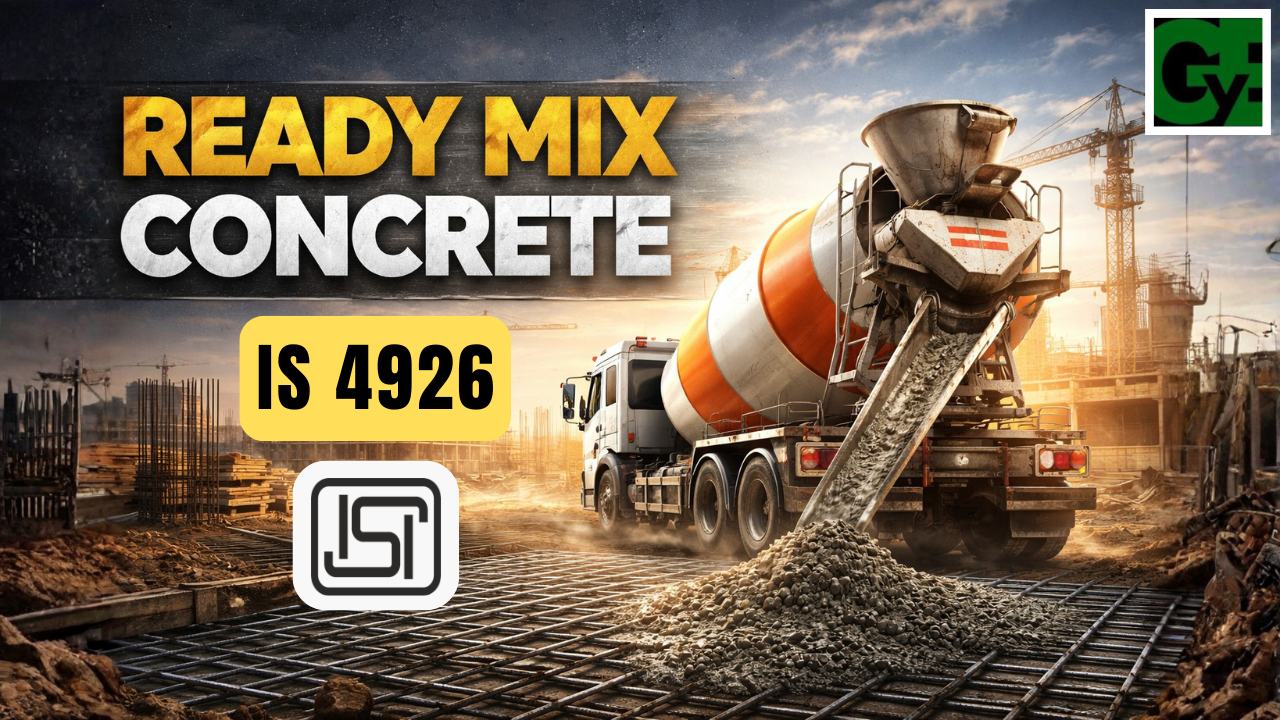
BIS License for Ready-Mix Concrete (RMC) is mandatory as it has become the most widely used construction material in the world, forming the backbone of infrastructure, buildings and urban development. However, the quality and durability of any concrete structure depend not just on design, but on how the concrete itself is produced, handled and placed. This is where Ready-Mix Concrete (RMC) has transformed the construction industry.
Understanding Concrete and Its Quality Drivers
Concrete is a composite material made from cement, fine aggregates, coarse aggregates, water and admixtures. Each ingredient plays a critical role in determining strength, workability, durability and long-term performance.
Modern concrete often incorporates:
- Mineral admixtures such as fly ash, slag, silica fume and metakaolin to improve durability and sustainability.
- Chemical admixtures like superplasticizers, retarders, and accelerators to enhance workability, control setting time and optimize performance.
Concrete quality is influenced by:
- Accurate proportioning of materials
- Proper mixing, transportation, placement, compaction, and curing
- Strict control over water–cement ratio
Even small deviations in these factors can significantly compromise strength and durability.
What Is Ready-Mix Concrete (RMC)?
Ready-Mix Concrete (RMC) is concrete that is manufactured at a central batching plant under controlled conditions and delivered to the construction site in a fresh, workable state. It can be mixed using:
- Stationary mixers at a central plant, or
- Truck-mounted transit mixers during transportation
Unlike site-mixed concrete, RMC ensures uniformity, consistency and reliability.
More importantly, RMC is both a material and a service. The supplier manages:
- Procurement and storage of raw materials
- Controlled production and quality assurance
- Timely delivery to site
This eliminates on-site mixing, reduces labour dependency, improves productivity, and ensures consistent quality across every batch.
Why RMC Matters: Key Advantages
- Superior Quality Control
RMC is produced in factory-controlled environments using computerized batching systems, resulting in consistent and predictable concrete performance. - Improved Mixing and Handling
Standardized mixing practices ensure uniform workability, strength, and durability. - Efficient Use of Cement and Admixtures
Optimized mix designs and admixture use reduce cement consumption, lowering costs and environmental impact. - Reduced Labour Dependency
Automated processes minimize reliance on skilled site labour and reduce human error. - Time Efficiency
Faster placement, pumping, and continuous supply significantly shorten construction cycles. - Controlled Hydration
The use of retarders and mineral admixtures allows better control of hydration during transportation, even for longer lead distances.
Challenges of Ready-Mix Concrete
Despite its advantages, RMC presents certain challenges:
- Cracking and shrinkage, which must be managed through proper design, reinforcement, and curing.
- Site accessibility, as fully loaded RMC trucks can weigh up to 32 tonnes. This is addressed through mini-mix trucks and smaller vehicles for congested urban areas.
With proper planning, these challenges are effectively manageable.
BIS Standards for RMC: Ensuring Reliability and Quality
In India, Ready-Mix Concrete is covered under IS 4926 – Code of Practice for Ready-Mix Concrete, issued by the Bureau of Indian Standards (BIS). This standard defines requirements for:
- Raw materials
- Batching accuracy
- Production, transportation, and delivery
- Quality control systems
- Safety, environmental, and documentation practices
BIS-certified RMC plants operate under a three-tier quality control system:
- Forward Control – Material selection, storage, mix design, and workability planning
- Immediate Control – Accurate batching, moisture correction, slump checks, and transit control
- Retrospective Control – Cube strength testing, statistical analysis, and corrective actions
This robust framework ensures traceability, transparency, and continuous improvement.
Safety, Sustainability and Documentation
Modern RMC plants follow strict safety protocols due to heavy machinery, silos, conveyors, and electrical systems. BIS certification mandates:
- Preventive maintenance schedules
- Environmental controls for dust, noise, and effluents
- Proper handling of fuels and chemicals
Each delivery is accompanied by a delivery ticket, providing batch details, mix design information and loading time – serving as proof of quality assurance.
Case Study: RMC in a Mid-Rise Commercial Project
The Orion Business Tower, a G+10 commercial building in Pune, illustrates the real-world benefits of RMC.
Challenges before RMC adoption included:
- Severe space constraints in a dense urban area
- Inconsistent quality from site-mixed concrete
- Skilled labour shortages
- Tight project timelines
After switching to BIS-certified RMC:
- Concrete placement rates increased from 25 m³/day to 80–100 m³/day
- Slab pour time reduced by 50%
- Overall project duration shortened by 2.5 months
- Material wastage dropped by 12%
- Labour costs reduced by 20%
- Cement consumption reduced through optimized admixture use
The project achieved uniform strength, minimal cracking, improved site safety, and cleaner working conditions, proving RMC to be a decisive factor in project success.
Key Takeaways
- RMC delivers consistent quality, speed, and reliability unmatched by site-mixed concrete
- Early coordination between client, engineer, and RMC supplier is essential
- BIS-certified plants provide assurance through documentation and traceability
- RMC is especially critical for urban, high-rise, fast-track, and space-constrained projects
Conclusion
Ready-Mix Concrete has become an indispensable solution for modern construction. By combining quality control, efficiency, safety, and sustainability, RMC not only improves structural performance but also enhances project economics and timelines. As urbanization and infrastructure demands continue to grow, BIS-certified RMC plants will remain the cornerstone of durable and dependable construction.
To get BIS Certification for Ready-Mix Concrete, contact GYE LLP, your trusted BIS consultancy service provider in India.
Email: satjindal@yahoo.co.in
Phone: +91 9313058678, 9718925753

Leave a Reply