
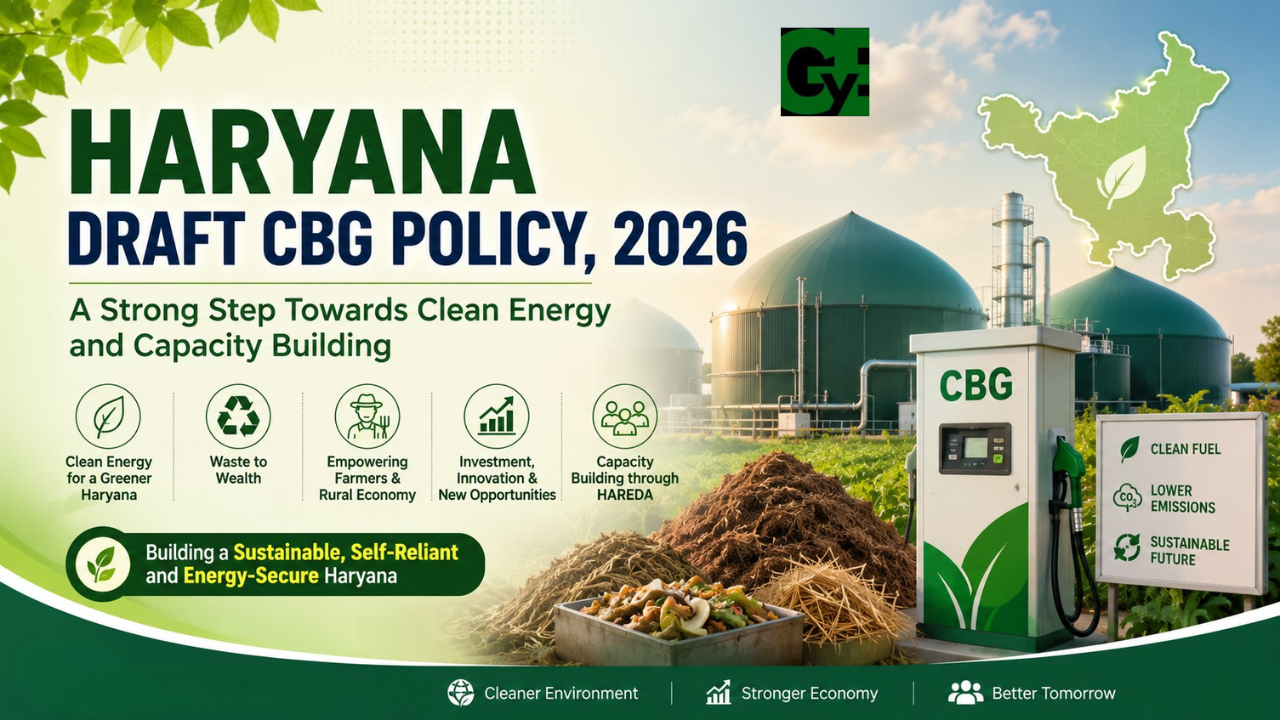
The Government of Haryana, through the New and Renewable Energy Department and HAREDA, has issued the Draft Haryana Compressed Biogas (CBG) Policy, 2026 and invited public comments and suggestions from stakeholders, industry associations, project developers, and the general public. This draft policy reflects a forward-looking vision for sustainable energy, waste management, rural income generation, and industrial development in the State. It is an important move towards creating a structured CBG ecosystem in Haryana, and it deserves appreciation for the direction it provides to clean energy development.
A policy built around waste-to-wealth
At its core, the draft CBG policy is based on a powerful idea: convert organic waste into clean fuel and valuable by-products. The policy recognises multiple biomass sources such as agricultural residue, animal dung, municipal solid waste, agro-industrial by-products, and dedicated energy crops as key feedstock for CBG production. It also aligns the fuel quality with BIS specifications, indicating that the resulting compressed biogas must meet the required standards for safe and efficient use.
This approach is especially meaningful for a state like Haryana, where agriculture plays a major role in the economy. Instead of allowing crop residue and organic waste to remain underutilised or burned openly, the policy encourages their productive use in energy generation. That means cleaner air, better waste management, and new economic value from materials that were previously seen as waste.
Why the draft policy is appreciable
The draft policy is appreciable because it does not stop at broad vision; it creates a practical framework for execution. It identifies clear targets for CBG capacity expansion, defines eligible feedstock, and proposes a supportive ecosystem for project development. It also positions CBG as part of Haryana’s wider clean energy transition and circular economy strategy.
Another important strength of the policy is its emphasis on facilitation. The draft proposes land support, utility support, time-bound approvals, and institutional coordination through HAREDA as the nodal agency. This is important because many energy and infrastructure projects face delays due to fragmented approvals. A policy that simplifies this process can significantly improve investor confidence and project viability.
A real opportunity for capacity building in Haryana
One of the most valuable outcomes of the draft policy is its potential to build capacity across the State. CBG is not just an energy project; it is an ecosystem that connects farmers, aggregators, transporters, local bodies, technical institutions, and entrepreneurs. The policy encourages aggregation of biomass, support for FPOs, training and awareness, and development of a structured supply chain. That means it can create skilled participation at every stage of the value chain.
For Haryana, this can translate into:
- better use of agricultural residues,
- improved farmer income,
- employment generation in rural areas,
- stronger waste management systems,
- and growth of local technical and operational expertise.
In this sense, HAREDA’s role is very important. By acting as the nodal agency, it can help convert policy intent into ground-level implementation, training, monitoring, and coordination. That is exactly how a draft policy becomes a real development tool.
Benefits for farmers, industry and the environment
The draft Haryana CBG Policy, 2026 has the potential to create wide-ranging benefits.
For farmers, it offers a new market for crop residue and organic biomass, while also supporting value addition and income generation. For industry and project developers, it creates a clearer path for setting up CBG plants with support measures, approvals, and incentives. For the environment, it offers a practical way to reduce open burning, minimise landfill burden, and support renewable fuel production.
This is especially important because CBG contributes to both energy security and environmental sustainability. It can replace fossil fuel use in suitable applications while also creating a circular model where waste becomes a resource.
Need for stakeholder participation
The government has invited comments and suggestions within 15 days from the date of publication of the notice. This shows that the policy is still open for improvement and stakeholder participation. That openness is a positive sign, because a strong policy becomes even stronger when it reflects the practical realities of farmers, developers, industry bodies, and local institutions.
Stakeholder participation is especially important in a sector like CBG, where feedstock management, land availability, logistics, and project economics all play a major role. By inviting feedback, Haryana is giving the ecosystem a chance to shape a more workable and implementation-ready policy.
Conclusion
The Draft Haryana CBG Policy, 2026 is an appreciable and timely initiative. It supports the shift towards clean energy, promotes waste-to-wealth development, and lays the foundation for long-term capacity building in Haryana. With HAREDA as the implementing agency, the policy has the potential to become a major enabler of investment, rural livelihoods, and sustainable energy growth in the State.
For Haryana, this is more than just a policy draft. It is a roadmap for a greener, cleaner, and more self-reliant future.

Leave a Reply